Free delivery on orders over €90 in mainland France!

Get a free gift with any purchase of €50 or more!

Réf : BM539
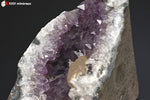
Minéral crisallisé d'une druse d'Améthyste et Calcite d'Uruguay
Amethyst geode druse with beautiful calcite - Uruguay - crystal minerals 10 cm / 608g / BM539 - Vignette | 1001 minéraux

Amethyst geode druse with beautiful calcite - Uruguay - crystal minerals 10 cm / 608g / BM539


Please select an available variant
Reduced price
95,00 €
Comparative price
95,00 €
Normal price
/
Unit price
Please select an available variant

Amethyst belongs to the silicate group. It contains mainly silicon. Its chemical formula is the same as that of Quartz or Agate, SiO2 .
It is a variety of quartz, purple in color due to its iron content. Yellow amethyst is called citrine.
Amethyst has a hardness of 7/10 on the Mohs scale (10 for diamond) and a density of 2.7 (1 for water). The streak on the porcelain is white.
AMETHYST is usually found in geodes, and those from Brazil produce large pyramidal crystals, while those from Uruguay are a deep purple and smaller.
Some amethysts exhibit unique characteristics such as "cactus" formations (tall crystals with secondary crystallization of smaller crystals), "flower" formations (crystals growing in all directions), and "hedgehog" formations (a domed chalcedony base with crystal growth). The amethyst known as "Vera Cruz" is distinguished by its long, thin, translucent crystals tinged with purple.
The name Amethyst comes from the Greek word amethustos and means against drunkenness .

Calcite belongs to the carbonate group and contains calcium and carbon. Its chemical formula is CaC₂O₃ , It has exactly the same properties as Aragonite or Limestone. It is a calcium carbonate. Calcite occurs in massive or crystalline form with beautiful crystal development, exhibiting various forms: dendritic, crested, nail-head, sandy, dog-tooth, etc. Its hardness is 3/10 on the Mohs scale (10 for diamond). and its density has an average value of 2.7 (1 for water). The streak on the porcelain is white. Calcite has a vitreous luster and a smooth feel. It exists in several color variations: brown, red, green, blue, yellow, and colorless. Transparent specimens exhibit birefringence and therefore produce a double image. The name comes from the Latin word calx , meaning lime .
Unique piece - Photos are of the actual item
Origin: Uruguay crystal minerals
Dimensions: 10 x 7.8 x 7 cm
Weight: 608 g

You may also like...

Your shopping cart is empty.

Why not try one of these products ?

Continue shopping