Agate


Introduction to Agate
Agate is a fascinating semi-precious stone, renowned for its characteristic colored bands and wide variety of patterns. Belonging to the quartz family, it has captivated collectors and mineral enthusiasts for millennia with its natural beauty and countless varieties.
Etymological origin and discovery
The name "Agate" originates from the Ancient Greek word "akhátēs" (ἀχάτης), which refers to the Achates River (now called the Dirillo) in Sicily, where these stones were supposedly first discovered in antiquity. The Greek naturalist and philosopher Theophrastus (372-287 BC), a disciple of Aristotle, was one of the first to mention and describe agate in his writings on gemstones.
Agate has been used since prehistoric times to make tools and ornaments. Mesopotamian, Egyptian, and Greek civilizations made extensive use of it to create seals, amulets, and decorative objects. In the 18th century, the German mineralogist Georgius Agricola (1494–1555) and later Abraham Gottlob Werner (1749–1817) contributed to its modern scientific classification.
Mineralogical properties
Composition and chemical formula
Agate belongs to the microcrystalline quartz group , more specifically to the chalcedony family. Its chemical formula is SiO₂ (silicon dioxide) .
The characteristic colored bands of agate are due to the presence of impurities and metallic oxides (iron, manganese, chromium, nickel) which were deposited during its formation in the cavities of volcanic rocks.
Physical characteristics
- Hardness: 6.5 to 7/10 on the Mohs scale, making it a hard but brittle stone
- Density: 2.7
- Crystal system: Hexagonal, microcrystalline structure
- Fracture: Conchoidal
- Transparency: Translucent to opaque
- Gloss: Waxy to vitreous
Color palette and varieties
Agate exhibits an extraordinary diversity of colours and patterns, making it one of the most varied stones in the mineral kingdom:
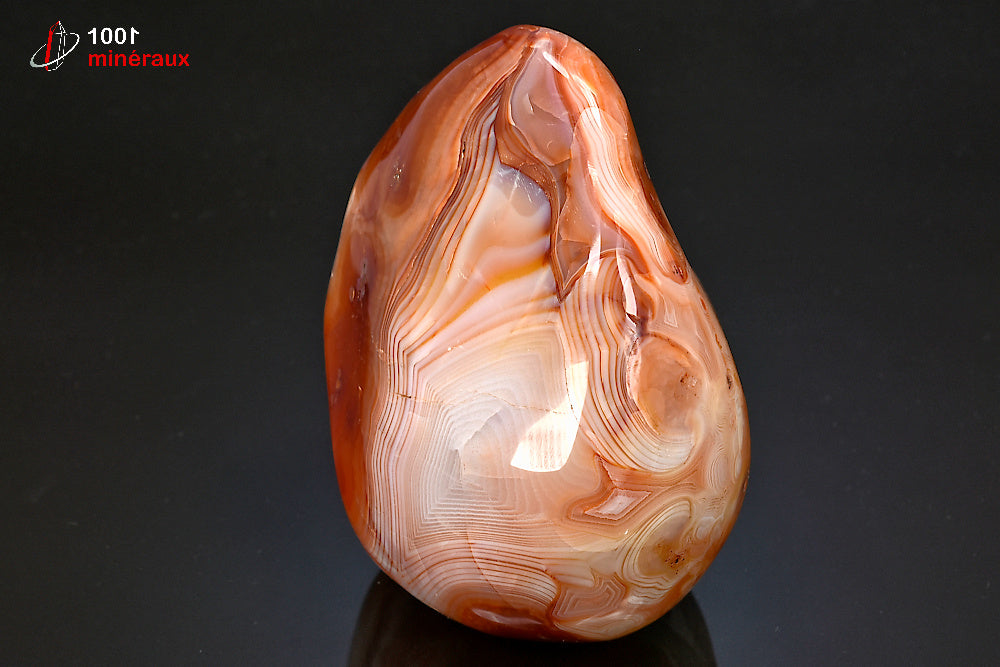
- Banded agate: Concentric bands of different colors (white, grey, brown, red, blue)
- Moss agate: Green inclusions of chlorite resembling moss or ferns
- Dendritic agate: Black or brown tree-like patterns
- Fire agate: Iridescent orange to red reflections
- Eye agate: Concentric circular patterns resembling an eye
- Landscape agate: Patterns evoking natural landscapes
- Snake skin agate: White and grey, resembling a shed skin.
- Blue Lace Agate: Light blue and white bands, not to be confused with blue chalcedony
- Botswana agate or banded agate: Very fine grey, pink and white bands
- Turritella agate: Black-brown fossil inclusions
- Onyx: A variety of agate with colored bands that can be black, brown, green
There are also artificially dyed agates to obtain bright colors (pink, purple, green, blue...), a common practice in the trade.

Natural Agate Slices

polished zoned agate

Pink-tinted agate slice

Polished Blue Lace Agate
Deposits and origins
Main producing countries
The most important agate deposits are located in:
- Germany: Idar-Oberstein region, historically important
- Brazil: The world's leading producer, particularly in the state of Rio Grande do Sul
- Botswana: Famous for its delicately banded Botswana agate
- United States: Montana, Oregon, Wyoming, South Dakota
- India: Wide variety of agates, including moss agates
- Madagascar: Agates with varied and colorful patterns
- Mexico: Fire agates and crazy lace agates
- Uruguay: Renowned for its high-quality agates with fine bands
- Australia, China, Morocco, Namibia...
Agate in France
France has several sites where agate can be found:
- Auvergne: In the volcanic formations of Puy-de-Dôme and Cantal
- Brittany: Particularly in Côtes-d'Armor and Finistère
- The French Riviera: The lithophyse agates of the Esterel Massif
- The Massif Central: Various localities with agates in basalts
- Normandy: Tumbled agates on some beaches
- The Pyrenees: A few isolated deposits
- The Vosges Mountains: Agates in ancient volcanic rocks
French agates, although less abundant than those from the large South American deposits, offer beautiful specimens for collectors and enthusiasts of local mineralogy.
Historical and cultural anecdotes
Historical anecdote: Mesopotamian seals
One of the oldest and most remarkable uses of agate dates back to ancient Mesopotamia, over 5,000 years ago. The Sumerians and Babylonians carved cylinder seals into agate, which served as personal signatures and marks of authenticity. These agate cylinders, rolled over fresh clay, left a raised impression depicting mythological scenes, deities, or cuneiform inscriptions. Agate's hardness allowed for fine and lasting engraving, and these seals were considered highly prized objects, often passed down through generations. Today, these agate seals are valuable artifacts preserved in museums around the world.
Cultural anecdote: The City of Agate
The German town of Idar-Oberstein, in Rhineland-Palatinate, has been known as the "Agate Capital of the World" since the Middle Ages. From the 15th century onwards, local artisans worked the region's agate deposits and developed exceptional skills in cutting and polishing the stones. In the 19th century, when the local deposits were depleted, the artisans imported agates from Brazil and Uruguay, thus perpetuating their tradition. Even today, Idar-Oberstein is home to renowned lapidary workshops, a gem museum, and hosts international mineral fairs. This town embodies the millennia-old history of agate working in Europe.
Symbolism of Agate
Throughout civilizations and eras, Agate has carried many symbolic meanings:
- Protection: Considered a protective stone against negative energies and the evil eye
- Balance and harmony: Its regular bands symbolize stability and balance
- Strength and courage: Stone of warriors in Antiquity
- Grounding and connection to the earth: Would promote rooting
- Prosperity: Associated with abundance in some cultures
- Longevity: A symbol of health and long life in Asia
- Creativity: Would stimulate artistic expression
Agate in crystal healing
Important warning: The following information regarding crystal healing falls within the realm of belief and tradition. Crystal healing is not a recognized science and cannot replace medical advice, treatment prescribed by a healthcare professional, or a medical consultation. In case of health problems, always consult a doctor or qualified healthcare professional.
Traditional uses
In the practice of crystal healing, agate is considered a grounding and stabilizing stone. According to the beliefs associated with this practice, it is used to:
- Grounding and stability: Would promote a feeling of security and connection to the earth
- Emotional balance: Helps to harmonize emotions and soothe tension
- Self-confidence: Would strengthen self-esteem and courage
- Energy protection: Would create a shield against negative influences
- Concentration: Would improve mental clarity and analytical skills
- Self-acceptance: Would promote introspection and acceptance
Specific properties depending on the variety
According to lithotherapy, each type of agate is said to have particular properties:
- Moss agate: Connection to nature, abundance, new beginnings
- Blue agate: Communication, expression, calming
- Fire agate: Vitality, passion, creativity
- Agate Botswana: Comfort, stress management, smoking cessation
- Dendritic agate: Personal growth, connection to nature
Associated Chakras
In crystal healing, agate is generally associated with the root chakra (the first chakra, located at the base of the spine) for its grounding properties. Depending on the color of the agate, it can also be associated with other chakras: blue agate with the throat chakra, green agate with the heart chakra, and so on.
Agate Care
To preserve the beauty of your Agate:
- Clean it regularly with lukewarm water and dry it with a soft cloth, except for dyed agates which will lose their color.
- Avoid harsh chemicals and detergents
- Recharge it in soft sunlight or on a cluster of quartz, according to lithotherapy practices.
- Purify it with smudging (sage, palo santo) or sound (Tibetan singing bowl)
- Avoid bumps and scratches by storing it separately from other stones
- This stone is brittle like glass (same chemical formula)
Conclusion
Agate, with its unique patterns and infinite palette of colors, remains one of the most prized and accessible stones in the mineral world. Whether you are fascinated by its geology, its millennia-old history, its natural beauty, or its traditional uses in crystal healing, each agate is a work of art created by nature.
At 1001 Minerals, we carefully select our agates to offer you authentic and unique specimens with exceptional patterns, sourced from the finest deposits worldwide. Each stone tells a unique geological story, captured in its colorful bands. That's why each agate specimen is photographed by us, ensuring you receive exactly the agate you've chosen!